

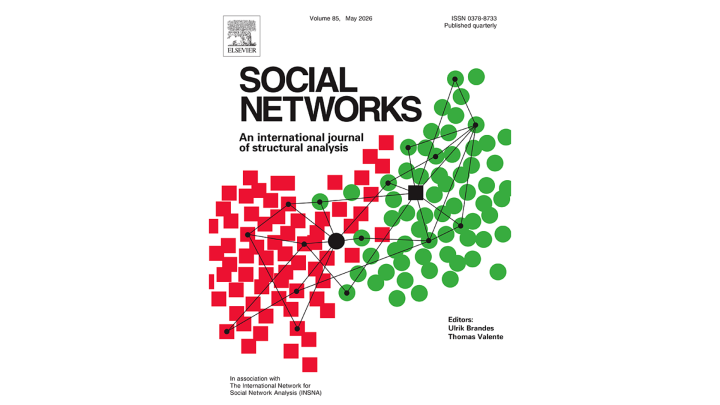
PATCHWORK members Miranda Lubbers and Michał Bojanowski and advisory board member Beate Völker have guest‑edited a new special issue of Social Networks devoted to the Network Scale‑Up Method (NSUM) and Aggregated Relational Data (ARD)—core methodological tools in the PATCHWORK project.
The special issue brings together 17 contributions by leading scholars from around the world.
The issue opens with a commentary by two of the method’s inventors, Russell Bernard and Christopher McCarty, who revisit the origins and foundations of NSUM:
- McCarty, C., & Bernard, H.R. (2026). Introduction to the Network Scale-up Method. Social Networks, 86, 271-272. https://doi.org/10.1016/j.socnet.2026.04.003
This is followed by the guest editors’ editorial, which synthesizes almost 40 years of NSUM research, drawing on over 300 studies and more than 80 surveys to trace changing trends in data collection, analytical strategies, and applications. The editorial also proposes a reporting protocol aimed at improving transparency and comparability across studies:
- Lubbers, M. J., Völker, B., & Bojanowski, M. (2026). From hidden populations to social structure: Evolution of the Network Scale-Up Method, Aggregated Relational Data, and their applications. Social Networks, 86, 273-286. https://doi.org/10.1016/j.socnet.2026.04.002
The remaining papers in the issue (some now available, others forthcoming) span a wide range of themes, including (1) Methodological advances in NSUM estimation, Bayesian modeling, and bias correction, (2) Applications of ARD to elections, political talk, occupational stratification, inequality, homelessness, and life‑course dynamics, and (3) Innovative uses of NSUM and ARD in agent‑based modeling and survey research.
- Almquist, Z. W., Kahveci, I., Kajfasz, O., Rothfolk, J., & Hagopian, A. (2026). Understanding the personal networks of people experiencing homelessness in King County, WA with aggregate relational data. Social Networks, 86, 150–172. https://doi.org/10.1016/j.socnet.2026.02.003
- Arevalillo, J.M., Ramírez, J.M., Díaz-Aranda, S., Aguilar, J., Fernández-Anta, A., Lillo, R. E., 2026. Network Scale-up Methods on Aggregated Relational Data to Estimate the Outcome of Elections. Social Networks, this special issue, not published yet.
- Baum, D. S. (2025). Explaining contact patterns in acquaintanceship networks: A new covariate-based model. Social Networks, 83, 79-91. https://doi.org/10.1016/j.socnet.2025.05.005
- Clay-Warner, J., Yi, H., Kawashima, T., Li, J., Okech, D., & Hassan, F. (2025). A comparison of top-coding strategies for aggregated relational data. Social Networks, 83, 50–61. https://doi.org/10.1016/j.socnet.2025.05.006
- Díaz-Aranda, S., Marcos Ramírez, J., Aguilar, J., Lillo, R. E., & Fernández Anta, A. (2026). Robust network scale-up method estimators. Social Networks, 84, 46–61. https://doi.org/10.1016/j.socnet.2025.08.002
- Espinosa-Rada, A., Bargsted, M., & Ortiz Ruiz, F. (2026). Occupational stratification and socioeconomic homogeneity in acquaintance networks. Social Networks, this special issue, not published yet.
- Feld, S., & McGail, A. (2026). Estimating unknown populations from informant reports using scale-up reference groups and capture-recapture inference. Social Networks, 86, 35–41. https://doi.org/10.1016/j.socnet.2026.01.003
- Hofstra, B., Jeroense, T., & Tolsma, J. (2026). The impact of dyads and extended networks on political talk: A factorial survey experiment in the Netherlands. Social Networks, 85, 66–79. https://doi.org/10.1016/j.socnet.2025.11.003
- Kmetty, Z., & Kisfalusi, D. (2026). Who are better at recalling names? Calibrating Survey Recall and Participation Biases with Individual-Level Digital Trace Data. Social Networks, this special issue, not yet published.
- Lee, Y., & Xu, X. (2026). Use of aggregated relational data in agent-based modeling. Social Networks, 84, 164–179. https://doi.org/10.1016/j.socnet.2025.09.004
- Muñoz Rojas, A. B., Plaza-Reveco, A. I., & Espinoza, V. (2026). When Do Acquaintance Networks Grow? Life Events, Civic Participation, and Social Dynamics. Social Networks, this special issue, not published yet.
- Plaza, A., Beck, G., Iturra-Sanhueza, J., Otero, G., & Muñoz, B. (2026). Networked inequality: The role of changes in network heterogeneity and network size in attitudes towards inequality. Social Networks, 84, 27–45. https://doi.org/10.1016/j.socnet.2025.07.008
- Vogel, B., Cummins, B., & Laga, I. (2026). Accounting for correlation and censoring in Bayesian Network Scale-up Method Models. Social Networks, 84, 101–109. https://doi. org/10.1016/j.socnet.2025.07.005
- Völker, B., Hofstra, B., Corten, R., & van Tubergen, F. (2025). Who’s in your extended network ? Analysing the size and homogeneity of acquaintanceship networks in the Netherlands. Social Networks, 83, 173–185. https://doi.org/10.1016/j.socnet.2025.05.007
- Ward, O. G., Smith, A. L., & Zheng, T. (2026). Bayesian Modeling for Aggregated Relational Data: A Unified Perspective. Social Networks, this special issue, not published yet.
Together, these contributions demonstrate the versatility of NSUM and ARD for studying social structure at scale and highlight new directions for future research.
We hope this special issue will serve as a reference point and inspiration for scholars working with NSUM, ARD, and related network measurement approaches.